
How to Play Defenders of Hogwarts
Last checked Oct 11 · Based on the official rulebook and how-to-play animations
Defenders of Hogwarts is a one-vs-many deck-building board game for 2–5 players. One player runs the Dark Arts. Everyone else plays a Hogwarts house, and each house races to be the first to collect two Defence Shields. This guide follows the six steps of the official how-to-play, then fills in the details the short animations leave out.
In 30 seconds:
- House players: play cards to move around the castle, collect three items, trade them for a Defence Shield. First to two shields wins, on their own.
- Dark Arts player: move freely through obstacles, bump house pawns back to the Great Hall, and push along the Dark Arts Path. Collect all three progress tokens, then get your pawns to the target location.
- Every time a house player refills their hand, the Dark Arts player gets closer to winning. That tension drives the whole game.
What's in the box
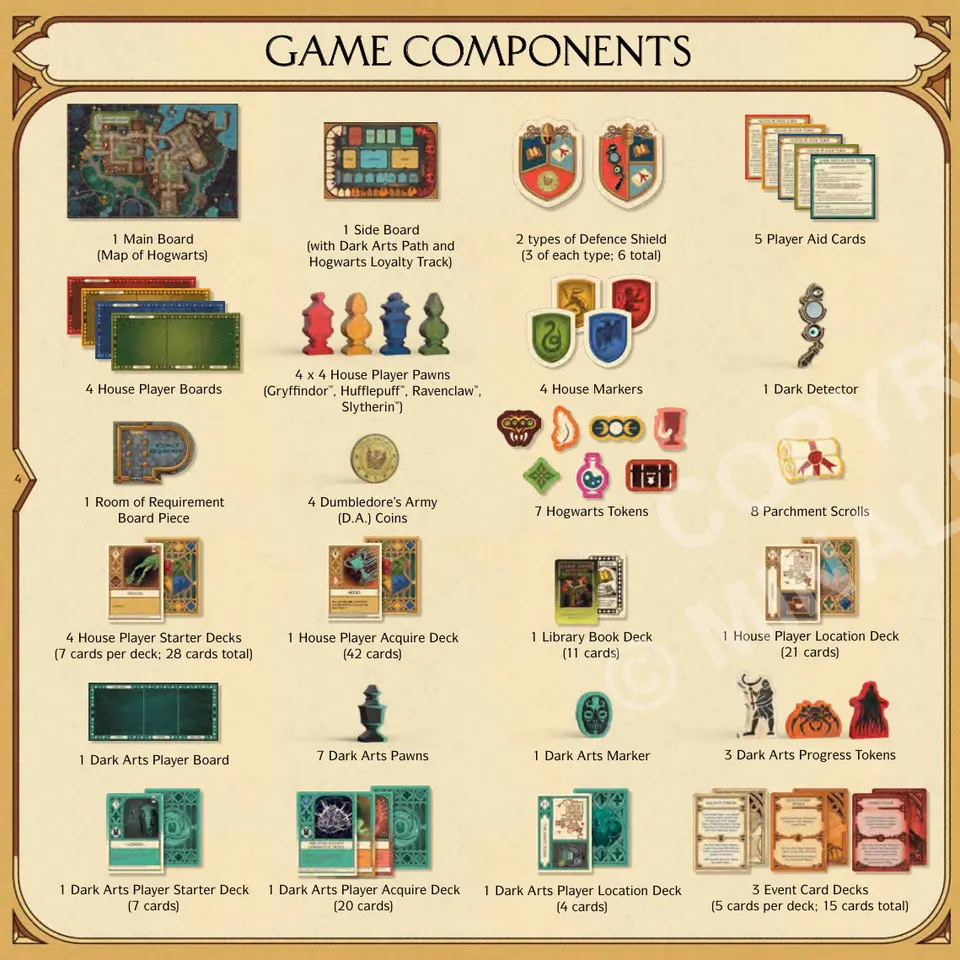
- Main Board The castle map where every pawn moves.
- Side Board Dark Arts Path and the Hogwarts Loyalty Track.
- Defence Shields 6 total: 3 need the Dark Detector, 3 need a D.A. Coin.
- Dark Detector Only 1 in the game. Goes to the highest Loyalty pawn on space 5+.
- Room of Requirement Opens once any house reaches Loyalty space 5.
- Dumbledore's Army Coins Taken in the Room of Requirement, 1 at a time.
- Hogwarts Tokens Return one for an extra Explore. Hold max 1.
- Parchment Scrolls Earned by reaching your Location Card targets.
- Library Book Deck One Book card goes into every shield.
- Dark Arts Pawns How many depends on the number of house players.
- Dark Arts Progress Tokens White, orange, red. The Dark Arts player needs all three.
- Event Card Decks Triggered as the Dark Arts Marker moves.
1. The Story & Goal
"Hogwarts castle has been infiltrated by Death Eaters and Dark Forces. It's only a matter of time before Lord Voldemort himself arrives, perhaps changing Hogwarts and altering the course of the wizarding world forever. Wands at the ready…"
The quote above is the full narration of this animation.
What this means: The table splits into two sides with different goals. Each House player controls one Hogwarts house and races the other houses to collect two Defence Shields. One player is the Dark Arts player, who works against everyone else and wins by finishing the Dark Arts Path and then getting pawns to a secret target location. House players are not a team. There is one winner, and the other houses lose along with the Dark Arts player.
Common mistake: Treating it as a co-op game. Houses can help each other indirectly, for example by keeping Dark Arts pawns busy, but only the first house to two shields wins.
Beginner tip: The rulebook recommends that the most experienced player, or whoever knows the rules best, takes the Dark Arts role for the first games. That player runs events and timing for the whole table.
Rulebook p.4–5 (Game Overview), p.8–9 (Dark Arts Player set up)
2. Explore the Castle
"Play a card and move your pawn, navigating Hogwarts castle and its grounds. Protective spells, locked doors, and more barriers block the House Player's way, but the Dark Arts Player can move through obstacles freely with their Dark magic. Beware! You will be bumped if a Dark Arts Pawn lands on your same space."
The quote above is the full narration of this animation.
What this means: Explore is one of your three Main Actions. Each turn you take exactly one of them. You play one card, move one of your un-stunned pawns up to the number in the card's top diamond, and resolve the card's effect before or after the move. A "3 + 3" card lets you move two pawns 3 spaces each, or one pawn 6. You can't split it any other way. Four obstacle types block House pawns: Locked Doors, Protective Spells, Physical Objects and Water. You can only cross them with a card effect that says so, and you can't backtrack within a turn.
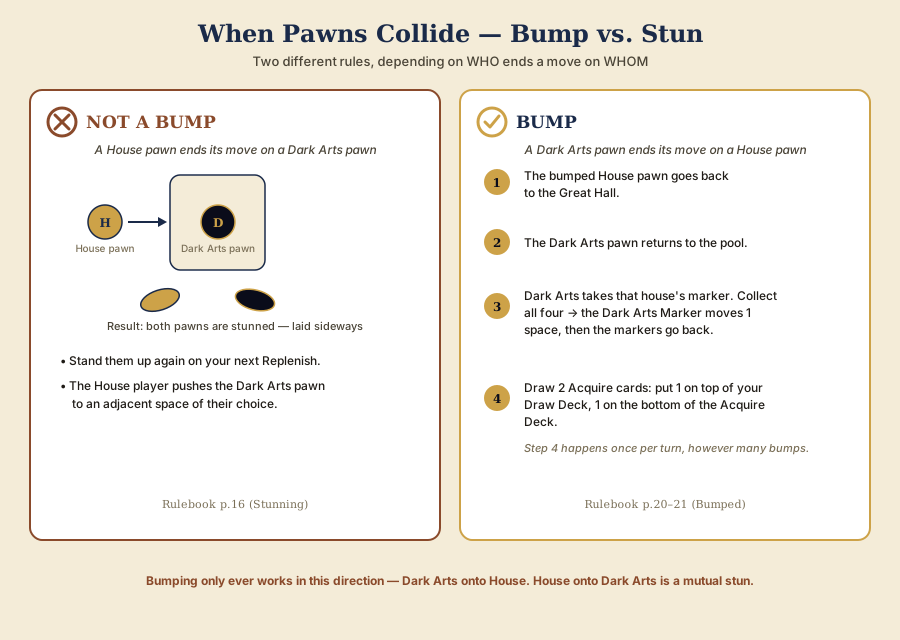
Common mistake: Ending your move on a Dark Arts pawn and expecting to bump it. It works the other way round. Both pawns are stunned (laid sideways), and you push the Dark Arts pawn to an adjacent space of your choice. Bumping only happens when a Dark Arts pawn ends on your space.
Beginner tip: End your move on a Bonus Space (Card Acquire, Card Draw or Play Again) whenever the route allows it. It's free value on top of your action. The four Protected Areas, marked with a blue shield, are the only spaces Dark Arts pawns can never enter.
Rulebook p.10 (Movement & Map Elements), p.16 (Explore, Stunning)
3. Learn Magical Skills
"Hone your magic and strengthen your hand by obtaining a card from the powerful Acquire Deck. In any given turn, House Players may choose to supplement their Starter Cards by trading cards from the Acquire Deck. The Dark Arts Player can draw from their Acquire Deck whenever they bump a House Player."
The quote above is the full narration of this animation.
What this means: Learn is a House-only Main Action, so it takes up your whole turn instead of Explore. You have three options. Discard 1 card and take one of the 2 face-up cards in the Acquire Row. Discard 1 card and take the top card of the Acquire Deck blind. Or discard 2 cards, take one of the 2 face-up cards in the Advanced Acquire Row, and also move up 1 space on the Hogwarts Loyalty Track. The new card goes face-down on top of your Draw Deck, so you will draw it next time you draw a card. You need at least one pawn outside every Protected Area to take this action.
Common mistake: Putting the new card in your hand or your discard pile. It goes on top of your Draw Deck. The other common slip is trying to Learn while all of your pawns are in Protected Areas.
Beginner tip: The 2-card Advanced option is often worth it early. The Loyalty step is the only way toward the Dark Detector and the Room of Requirement, and you need one of those for every shield (see step 5).
Rulebook p.17 (Learn), p.18 (Hogwarts Loyalty Track)
4. Replenish Your Deck
"Restore your abilities for the battle ahead by refilling your hand with a fresh set of cards from your Draw Deck. Each time a House Player chooses to replenish their hand, the Dark Arts Player moves further along the Dark Arts Path towards victory. Merlin's Beard!"
The quote above is the full narration of this animation.
What this means: Replenish is your third Main Action, and it has three steps in order. First, discard any number of cards and draw until you hold 5. Second, stand up all of your stunned pawns. Third, move the Dark Arts Marker 1 space along the Dark Arts Path. When your Draw Deck runs out, shuffle your discard pile into a new deck, so good cards come back around. Cards you draw from events, Library Books or Bonus Spaces do not move the marker. Only Replenish does.
Common mistake: Forgetting step 3. Every Replenish advances the Dark Arts Marker, and that marker is the game clock. It is also how the Dark Arts player unlocks orange and red card effects.
Beginner tip: Use up your hand before you refill it. A turn spent replenishing with 3 playable cards still in hand gives the Dark Arts player a free step. Card Draw bonus spaces let you top up without moving the clock.
Rulebook p.12 (Card Draw), p.17 (Replenish)
5. Build Your Defence
"Search Hogwarts to collect an array of wizarding items needed to acquire a Defence Shield. House Players must gather one Library Book Card, one Parchment Scroll, and one Dark Detector OR one Dumbledore's Army Coin before collecting a Defence Shield."
The quote above is the full narration of this animation.
What this means: Each shield costs three items, and you hand all three in when your pawn lands on a Defence Shield Space.
| Item | How you get it | Limit |
|---|---|---|
| Library Book Card | Land in the Library and take one of the 2 face-up books. Its effect resolves immediately. | 1 at a time |
| Parchment Scroll | Have pawns in 2 of the 3 locations on your House Player Location Cards, then reveal and discard those 2 cards. This is a Free Action. | 2 per game |
| Dark Detector | Be the highest pawn on the Hogwarts Loyalty Track, on space 5 or above | Only 1 in the game |
| D.A. Coin | Enter the Room of Requirement. It appears once any house reaches Loyalty space 5. | 1 at a time |
There are 6 shields. Three need the Dark Detector and three need a D.A. Coin. The shield on the space tells you which one.
Common mistake: Walking to a shield with the wrong third item. A Detector shield won't accept a Coin, and a Coin shield won't accept the Detector. Check the shield face before you plan your route. Also note that handing in the Detector drops your Loyalty pawn back 3 spaces.
Beginner tip: Spread your three pawns across your Location Card targets early. A scroll costs no action, so you can claim one in the middle of an Explore turn. The Room of Requirement closes again once every house is below Loyalty space 5, so take a Coin while it's open.
Rulebook p.11 (Defence Shield Space, Library), p.12–13 (Parchment Scroll, Dark Detector, D.A. Coin), p.17 (Gain a Parchment Scroll), p.18–19 (Loyalty Track, Room of Requirement)
6. Win the Game
"House Player: Secure two Defence Shields to win. Dark Arts Player: Secure all tokens from the Dark Arts Path and navigate to the Dark Arts Player Locations to win."
The quote above is the full narration of this animation.
What this means: A House player wins the moment they hold any 2 Defence Shields. The Dark Arts player needs two things. First, all 3 Dark Arts Progress Tokens, one from each zone (white, orange, red) of the Dark Arts Path. Second, enough pawns on the secret Dark Arts Player Location at the same time. That number depends on when they draw the Location Card:
- At the first red Event Space: 3 pawns
- At the second red Event Space: 2 pawns
- At the last space of the path: 1 pawn
Common mistake: Skipping a zone's token. The Dark Arts player must take each zone's Progress Token before the marker moves into the next zone, even when the Event Card looks better.
Beginner tip (House players): Watch the marker more than your rivals. Once it reaches red, the Dark Arts player is close to winning, and every Replenish helps them. Beginner tip (Dark Arts): Waiting for a later red space cuts the number of pawns you need, but it gives the houses more turns to finish their shields.
Rulebook p.4–5 (Game Overview), p.22–23 (Dark Arts Path, Game End)
Before your first turn
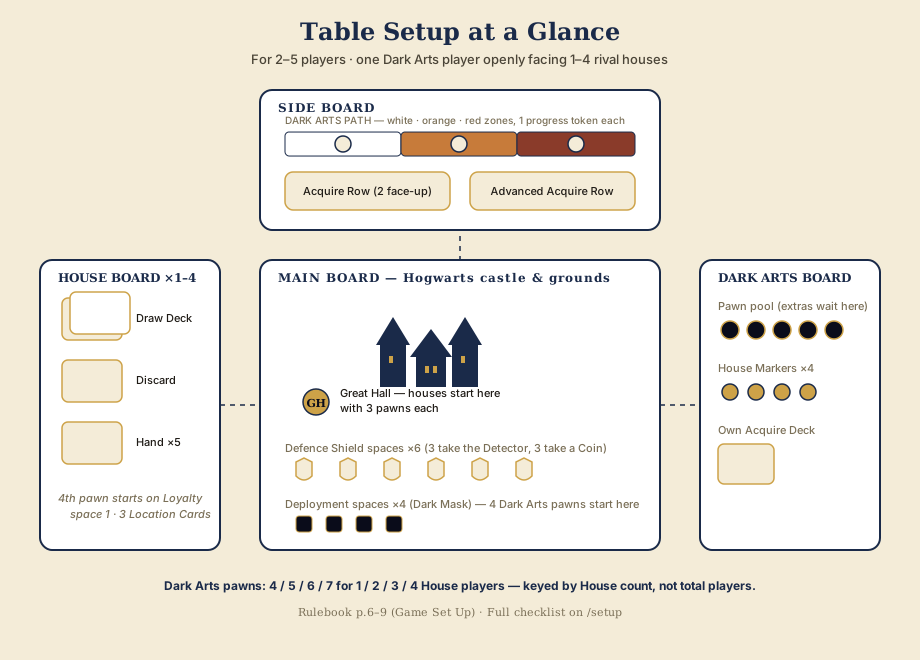
This section is a summary. The full checklist is on /setup.
- Choose the Dark Arts player first. Everyone else picks a house.
- Each house puts 3 of its 4 pawns in the Great Hall. The 4th pawn starts on space 1 of the Hogwarts Loyalty Track.
- The Dark Arts player gets 4 / 5 / 6 / 7 pawns for 1 / 2 / 3 / 4 House players. Four of them start on the Deployment Spaces in the grounds (marked with the Dark Mask), and any extras go in a pool.
- Each House player draws 5 Starter cards and 3 House Player Location Cards. The Dark Arts player draws 5 Starter cards.
- The House player to the Dark Arts player's left goes first, and play continues clockwise.
Rulebook p.6–9 (Game Set Up), p.10 (General Key Concepts)
The Dark Arts turn & Bump
The Dark Arts player only has two Main Actions, Explore and Replenish. They can't Learn.
- Explore: Movement works the same as for houses, but Dark Arts pawns pass through obstacles freely. They can never enter a Protected Area. Bringing a pawn in from the pool costs 1 movement point and places it on an empty Deployment Space.
- Card effects unlock by colour. White effects work from the start. Orange effects unlock once the marker reaches the first orange space, and red effects once it reaches the first red space.
- Replenish: Stand pawns up, then draw to 5. Dark Arts can't discard first, and their Replenish doesn't move the marker.
Bump, when a Dark Arts pawn ends its move on a space with a House pawn:
- If several House pawns share the space, the Dark Arts player picks one.
- That House pawn goes back to the Great Hall, and the Dark Arts pawn goes back to the pool.
- The Dark Arts player takes that house's House Marker. Once they hold every house's marker, the Dark Arts Marker advances 1 space and the markers go back.
- The Dark Arts player draws 2 cards from their Acquire Deck, puts 1 on top of their Draw Deck, and puts the other on the bottom of the Acquire Deck. This step happens once per turn, no matter how many bumps.
Rulebook p.20–21 (Dark Arts Player Turn, Bumped)
How the game ends
There are three outcomes:
| Result | Trigger |
|---|---|
| House win | A House player holds 2 Defence Shields |
| Dark Arts win | All 3 Progress Tokens taken, plus the required number of Dark Arts pawns (3, 2 or 1) on the Location at the same time |
| Draw | The marker reaches the last space of the path. Everyone draws up to 5 with no more Replenish, and all cards run out before anyone wins. |
The Dark Arts Marker advances when a House player Replenishes, when an event says so, or when the Dark Arts player collects every House Marker. Landing on an Event Space means drawing that zone's Event Card. House players resolve their half first. Then the Dark Arts player chooses either the event's effect or that zone's Progress Token.
Rulebook p.22–23 (Dark Arts Path, Resolving an Event Card, Game End)
Quick reference
| Your turn (House) | Pick 1 Main Action |
|---|---|
| Explore | Play 1 card: move and/or effect, in either order |
| Learn | Discard 1 → Acquire Row or top of deck · Discard 2 → Advanced Row + 1 Loyalty |
| Replenish | Discard any → draw to 5 → stand up pawns → marker +1 |
| Free: Hogwarts Token | Return the token for an extra Explore with a card of the same type |
| Free: Parchment Scroll | Reveal 2 matching Location Cards |
| Limit | Value |
|---|---|
| Hogwarts Tokens held | 1 |
| Library Book Cards held | 1 |
| D.A. Coins held | 1 |
| Parchment Scrolls | 2 per player per game |
| Dark Detector | 1 in the game |
| Hand size after Replenish | 5 |
Rulebook p.11, p.16–17, p.24–25 (Icon Quick Reference, Glossary)